
Resources on Justice, Mercy, the Church, & the Bible

“I could never myself believe in God, if it were not for the cross. . . . In the real world of pain, how could one worship a God who was immune to it?"
“With compelling honesty John Stott confronts readers with the centrality of the cross in God's redemption of our pain-filled world. Can we see triumph in tragedy, victory in shame? Why should an object of Roman distaste and Jewish disgust be the emblem of our worship and the axiom of our faith? And what does it mean for us today?
From one of the foremost preachers and Christian leaders of his generation, The Cross of Christ is a classic, accessible, and compelling look at the work of Christ. At the cross Stott finds the majesty and love of God disclosed, the sin and bondage of the world exposed. More than a study of the atonement, this book brings Scripture into living dialogue with Christian theology and contemporary issues. What emerges is a pattern for Christian life and worship, hope and mission.”

Christianity Today 2017 Book of the Year
“Though the apostle Paul boldly proclaimed ‘Christ crucified’ as the heart of the gospel, Fleming Rutledge notes that preaching about the cross of Christ is remarkably neglected in most churches today. In The Crucifixion: Understanding the Death of Jesus Christ, Rutledge addresses the issues and controversies that have caused pastors to speak of the cross only in the most general, bland terms, precluding a full understanding and embrace of the gospel by their congregations.
Countering our contemporary tendency to bypass Jesus' crucifixion, Rutledge in these pages examines in depth all the various themes and motifs used by the New Testament evangelists and apostolic writers to explain the meaning of the cross of Christ. She mines the classical writings of the Church Fathers, the medieval scholastics, and the Reformers as well as more recent scholarship, while bringing them all into contemporary context.”
Watch Rev. Rutledge teach on the Crucifixion here.

The church is at its best when it pursues the biblical value of unity in diversity.
“Our world has been torn asunder by racial, ethnic, and ideological differences. It is seen in our politics, felt in our families, and ingrained in our theology. Sadly, the church has often reinforced these ethnic and racial divides. To cast off the ugliness of disunity and heal our fractured humanity, we must cultivate spiritual practices that help us pursue beautiful community.
In The Beautiful Community, pastor and theologian Irwyn Ince boldly unpacks the reasons for our divisions while gently guiding us toward our true hope for wholeness and reconciliation. God reveals himself to us in his trinitarian life as the perfection of beauty, and essential to this beauty is his work as Father, Son, and Holy Spirit. The gospel imperative to pursue the beautiful community—unity in diversity across lines of difference—is rooted in reflecting the beautiful community of our triune God. This book calls us into and provides tools for that pursuit.”
Watch Rev. Dr. Ince explain the heart of his book here.

Winner of the 2022 ECPA Christian Book Award for Faith & Culture
“How do we effectively confront racial injustice? We need to move beyond talking about racism and start equipping ourselves to fight against it.
In this follow-up to the New York Times Bestseller The Color of Compromise, Jemar Tisby offers an array of actionable items to confront racism. How to Fight Racism introduces a simple framework--the A.R.C. Of Racial Justice--that teaches readers to consistently interrogate their own actions and maintain a consistent posture of anti-racist behavior.
The A.R.C. Of Racial Justice is a clear model for how to think about race in productive ways: Awareness: educate yourself by studying history, exploring your personal narrative, and grasping what God says about the dignity of the human person / Relationships: understand the spiritual dimension of race relations and how authentic connections make reconciliation real and motivate you to act. / Commitment: consistently fight systemic racism and work for racial justice by orienting your life to it.
Tisby offers practical tools for following this model and suggests that by applying these principles, we can help dismantle a social hierarchy long stratified by skin color. He encourages the rejection of passivity and in its place active participation in the struggle for human dignity. There is hope for transforming our nation and world, and you can be part of the solution.”
Watch Dr. Tisby lecture on this critical topic here.
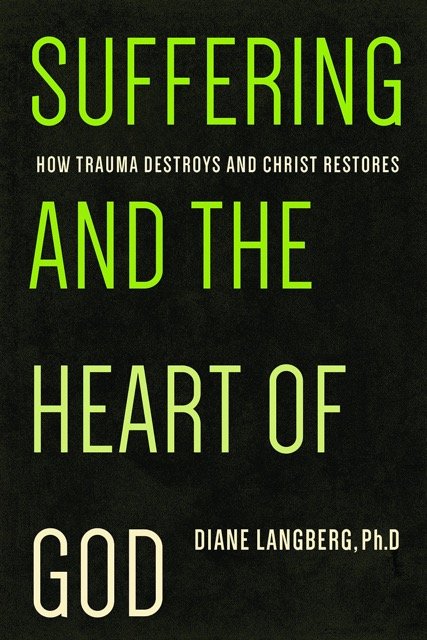
How trauma destroys and Christ restores.
“Do trauma and abuse have the last word?
When someone suffers through trauma, can healing happen? And, if yes, how does it happen? Dr. Diane Langberg tackles these complex and difficult questions with the insights she has gained through more than forty years of counseling those whose lives have been destroyed by trauma and abuse. Her answer carefully explained in Suffering and the Heart of God is Yes, what trauma destroys, Jesus can and does restore.”
Read an interview with Dr. Langberg about her book here.
Watch Dr. Langberg teach on Suffering and the Heart of God here.

Understanding Authority and Abuse in the Church
“Power has a God-given role in human relationships and institutions, but it can lead to abuse when used in unhealthy ways. Speaking into current #metoo and #churchtoo conversations, Redeeming Power shows that the body of Christ desperately needs to understand the forms power takes, how it is abused, and how to respond to abuses of power.
Although many Christians want to prevent abuse in their churches and organizations, they lack a deep and clear-eyed understanding of how power actually works. Internationally recognized psychologist Diane Langberg offers a clinical and theological framework for understanding how power operates, the effects of the abuse of power, and how power can be redeemed and restored to its proper God-given place in relationships and institutions. This book not only helps Christian leaders identify and resist abusive systems but also shows how they can use power to protect the vulnerable in their midst.”
Watch an online conversation with Dr. Langberg about her book here.
More of her counseling resources on a variety of topics may be found here.

Choosing Freedom and Courage in a Divided World
“A Sojourner's Truth is an African American girl’s journey from South Carolina to the United States Naval Academy, and then to her calling as an international speaker, mentor, and thought-leader.
Intertwined with Natasha's story is the story of Moses, a leader who was born into a marginalized people group, resisted the injustices of Pharaoh, denied the power of Egypt, and trusted God even when he did not fully understand where he was going. Along the way we explore the spiritual and physical tensions of truth telling, character and leadership development, and bridge building across racial, ethnic, socioeconomic, and gender lines.
Join the journey to discover your own identity, purpose, and truth-revealing moments.”
Watch Dr. Robinson explain the heart of her book here.
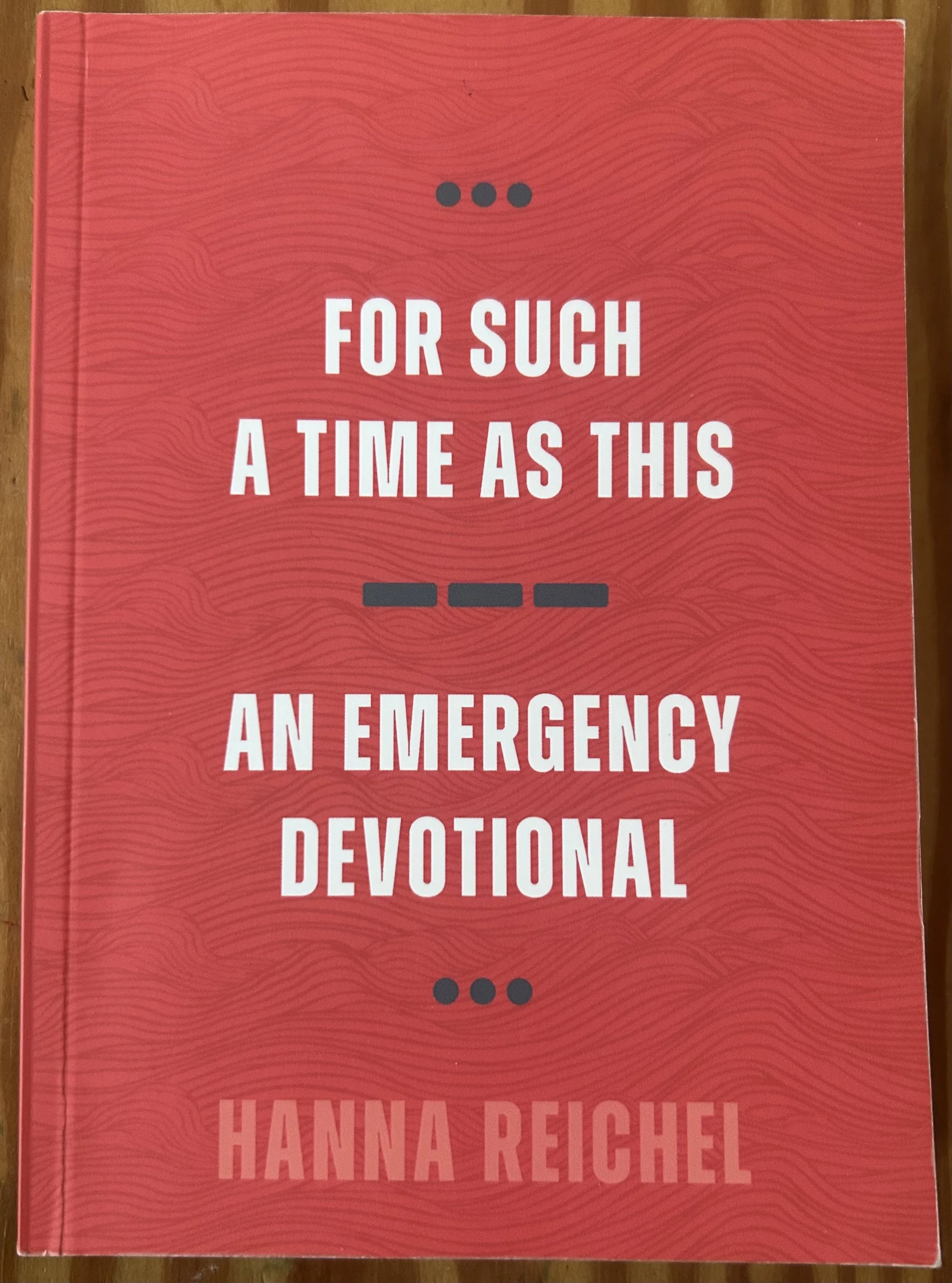
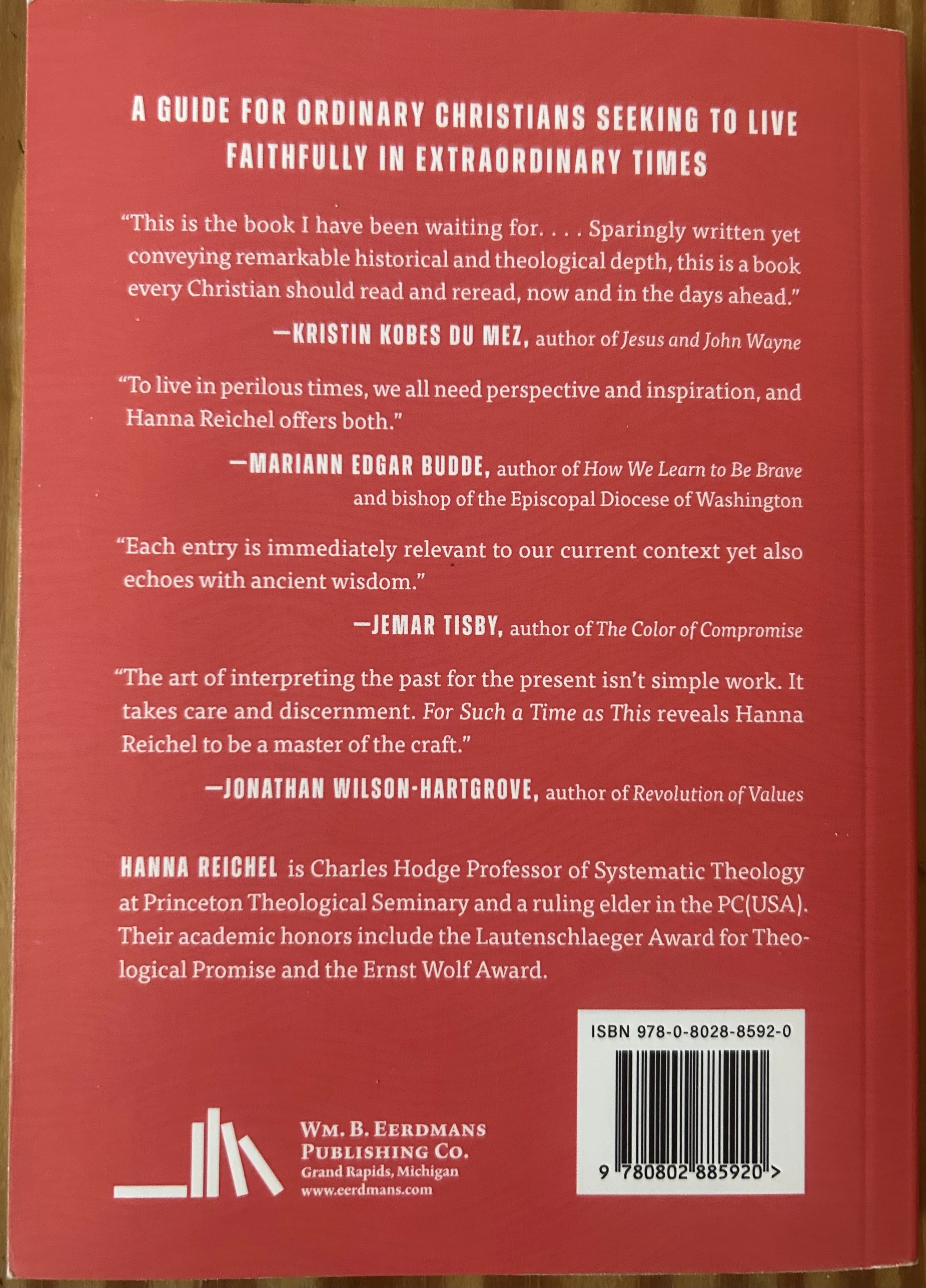
A Guide for Ordinary Christians Seeking to Live Faithfully in Extraordinary Times
“This is not the first end of the world. Many worlds have ended.”
In an era of political polarization, eroding democratic norms, and rising authoritarianism, many Christians find themselves disoriented, wondering how their faith should inform myriad daily decisions. Drawing upon both scholarship and pastoral wisdom, theologian Hanna Reichel offers a timely resource for believers seeking spiritual grounding amid societal upheaval.
For Such a Time as This provides a thoughtful framework for discernment rooted in scripture, historical wisdom, and the core commitments of Christian faith. Through meditations on scripture, reflections on historical precedents including the Confessing Church’s resistance to Nazi Germany, and portraits of inspiring figures who maintained their integrity in the face of oppression, Reichel guides readers toward their own Christian response to the present moment.
Written specifically for ordinary believers, this accessible volume acknowledges that while some are called to dramatic public witness, all must face the daily challenge of living faithfully as long-established institutions and systems reveal their fragility. Neither alarmist nor complacent, Reichel reminds readers that Christians throughout history have faced the collapse of worlds they once took for granted—and have discovered unexpected liberation in the process.
For anyone troubled by current political trends and searching for ways to disentangle faith in God from misplaced trust in political systems, For Such a Time as This offers both challenge and comfort. Readers will come away with practical wisdom for navigating our uncertain times, a deeper understanding of Christianity’s resources for resistance, and renewed energy for the urgent tasks that faithful discipleship demands today.
“None of this is unprecedented; what is unprecedented is that today it is we who have to do the hard work of seeing idols smashed, grieving and picking up the pieces, holding them into the sun, and seeing new refractions of light in their edges.”

Healing Your Community from Emotional and Spiritual Abuse
"If you wonder why family and friends have left the church or why you often feel more lost than found when you step into the sanctuary, When Narcissism Comes to Church is for you. Whether you're the pastor or the parishioner, Chuck DeGroat asks the stark-raving honest questions about church and church leadership that most of us are afraid to voice, even though they simmer in our hearts and leave us hot with confusion and emptiness. This book will not challenge you to pick up stones and throw them through stained-glass windows, but it will engage you to look within and find your true North Star to follow through the wilderness of church to an authentic spirituality of living, serving, worshipping, inviting, and communing in love tethered to something far greater than our small denominations, building programs, or evangelism crusades—to Someone far greater than ourselves." (Sharon A. Hersh, therapist and author)
Listen to an interview with Dr. DeGroat here.

How the Church Needs to Rediscover Her Purpose
“Recovering from Biblical Manhood and Womanhood dismantles every mistruth that you've heard about the role of women in the Bible, her place in the church, and the patriarchal lie of so-called ‘biblical manhood and womanhood.’ In its place, Aimee Byrd details a truly biblical vision of women as equal partners in Christ's church and kingdom.
The church is the school of Christ, commissioned to discipleship. The responsibility of every believer—men and women together—is being active and equal participants in and witnesses to the faith. And yet many women are trying to figure out what their place is in the church, fighting to have their voices heard and filled with questions.
The answers lie neither with those who claim that the Bible is hopelessly patriarchal, nor with the defenders of ‘biblical manhood,’ whose understanding of Scripture is captive to the culture they claim to distance themselves from.
This book presents a more biblical account of gender, marriage, and ministry. It explores the feminine voice in Scripture as synergistic with the dominant male voice. It fortifies churches in a biblical understanding of brotherhood and sisterhood in God's household and the necessity of learning from one another in studying God's word.”
Watch Aimee Byrd explain the heart of her book here.
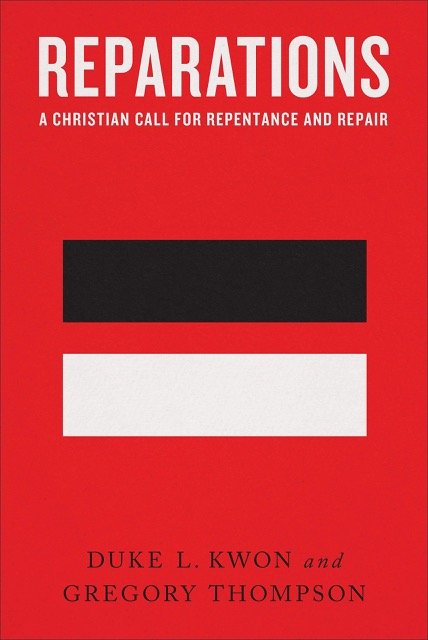
Reparations: A Christian Call for Repentance and Repair
Christianity Today 2022 Book Award Winner / Outreach 2022 Resource of the Year
“Christians are awakening to the legacy of racism in America like never before. While public conversations regarding the realities of racial division and inequalities have surged in recent years, so has the public outcry to work toward the long-awaited healing of these wounds. But American Christianity, with its tendency to view the ministry of reconciliation as its sole response to racial injustice, and its isolation from those who labor most diligently to address these things, is underequipped to offer solutions. Because of this, the church needs a new perspective on its responsibility for the deep racial brokenness at the heart of American culture and on what it can do to repair that brokenness.
Reparations: A Christian Call for Repentance and Repair makes a compelling historical and theological case for the church’s obligation to provide reparations for the oppression of African Americans. Duke Kwon and Gregory Thompson articulate the church’s responsibility for its promotion and preservation of white supremacy throughout history, investigate the Bible’s call to repair our racial brokenness, and offer a vision for the work of reparation at the local level. They lead readers toward a moral imagination that views reparations as a long-overdue and necessary step in our collective journey toward healing and wholeness.”
Watch a trailer for the book here, and listen to a conversation with the authors here.
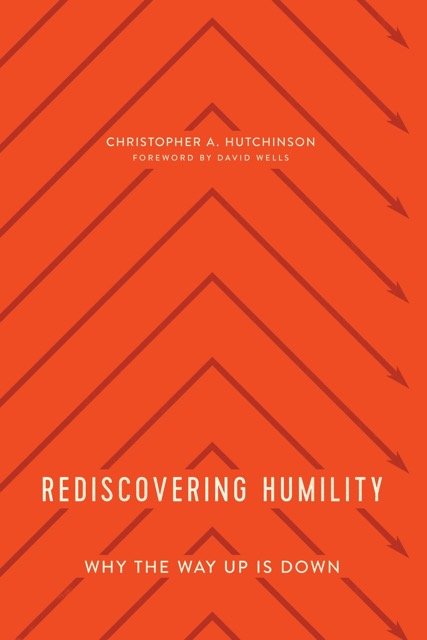
Why the Way Up is Down
“Most of us value humility . . . especially in other people. But Jesus taught that humility is central to the Christian life. Author Christopher Hutchinson invites the church to follow Christ—both individually and corporately—in this high calling.
A systematic and comprehensive treatment of this core tenant of Christianity, Rediscovering Humility is structured around the three times Jesus addresses the topic in Scripture—how it is found, embraced and applied. Pastors and church leaders will find Hutchinson’s critiques and suggestions helpful as they seek to create humble and healthy churches. Individuals who have lost an appreciation for humility as a central Christian virtue will be reminded of its value as the best way to grow closer to and more like Jesus.
Humble Christians create healthy churches, but in today’s world of celebrity pastors and widening platforms, our churches are more than ever imitating the prideful methodologies of our culture. Through his critiques, Hutchinson also offers suggestions for how Christians can better practice and promote humility in our time.
Offering a fresh and updated application of humility to our day, Hutchinson calls for a return to the path of humility as the one pilgrimage most necessary for Christian faith and life. By showing humility in in all its truth, beauty and goodness, it becomes a value worth seeking on this side of heaven.”
The Bible:
Eugene Peterson’s Introduction to The Message
Reading is the first thing, just reading the Bible. As we read we enter a new world of words and find ourselves in on a conversation in which God has the first and last words. We soon realize that we are included in the conversation. We didn't expect this. But this is precisely what generation after generation of Bible readers do find: The Bible is not only written about us but to us. In these pages we become insiders to a conversation in which God uses words to form and bless us, to teach and guide us, to forgive and save us.
We aren't used to this. We are used to reading books that explain things, or tell us what to do, or inspire or entertain us. But this is different. This is a world of revelation: God revealing to people just like us—men and women created in God's image—how God works and what is going on in this world in which we find ourselves. At the same time that God reveals all this, God draws us in by invitation and command to participate in God's working life. We gradually (or suddenly) realize that we are insiders in the most significant action of our time as God establishes his grand rule of love and justice on this earth (as it is in heaven). "Revelation" means that we are reading something we couldn't have guessed or figured out on our own. Revelation is what makes the Bible unique.
And so just reading this Bible . . . and listening to what we read, is the first thing. There will be time enough for study later on. But first, it is important simply to read, leisurely and thoughtfully. We need to get a feel for the way these stories and songs, these prayers and conversations, these sermons and visions, invite us into this large, large world in which the invisible God is behind and involved in everything visible and illuminates what it means to live here—really live, not just get across the street.
As we read, and the longer we read, we begin to "get it"—we are in conversation with God. We find ourselves listening and answering in matters that most concern us: who we are, where we came from, where we are going, what makes us tick, the texture of the world and the communities we live in, and—most of all—the incredible love of God among us, doing for us what we cannot do for ourselves.
Through reading the Bible, we see that there is far more to the world, more to us, more to what we see and more to what we don't see—more to everything!—than we had ever dreamed, and that this "more" has to do with God.
This is new for many of us, a different sort of book—a book that reads us even as we read it. We are used to picking up and reading books for what we can get out of them: information we can use, inspiration to energize us, instructions on how to do something or other, entertainment to while away a rainy day, wisdom that will guide us into living better. These things can and do take place when reading the Bible, but the Bible is given to us in the first place simply to invite us to make ourselves at home in the world of God, God's Word and world, and become familiar with the way God speaks and the ways in which we answer him with our lives.
Our reading turns up some surprises. The biggest surprise for many is how accessible this book is to those who simply open it up and read it. Virtually anyone can read this Bible with understanding. The reason that new translations are made every couple of generations or so is to keep the language of the Bible current with the common speech we use, the very kind of language in which it was first written. We don't have to be smart or well-educated to understand it, for it is written in the words and sentences we hear in the marketplace, on school playgrounds, and around the dinner table.
Because the Bible is so famous and revered, many assume that we need experts to explain and interpret it for us—and, of course, there are some things that need to be explained. But the first men and women who listened to these words now written in our Bibles were ordinary, everyday, working-class people. One of the greatest of the early translators of the Bible into English, William Tyndale, said that he was translating so that the "boy that driveth the plough" would be able to read the Scriptures.
One well-educated African man, who later became one of the most influential Bible teachers in our history (Augustine), was greatly offended when he first read the Bible. Instead of a book cultivated and polished in the literary style he admired so much, he found it full of homespun, earthy stories of plain, unimportant people. He read it in a Latin translation full of slang and jargon. He took one look at what he considered the "unspiritual" quality of so many of its characters and the everydayness of Jesus, and he contemptuously abandoned it. It was years before he realized that God had not taken the form of a sophisticated intellectual to teach us about highbrow heavenly culture so we could appreciate the finer things of God. When he saw that God entered our lives as a Jewish servant in order to save us from our sins, he started reading the book gratefully and believingly.
Some are also surprised that Bible reading does not introduce us to a "nicer" world. This biblical world is decidedly not an ideal world, the kind we see advertised in travel posters. Suffering and injustice and ugliness are not purged from the world in which God works and loves and saves. Nothing is glossed over. God works patiently and deeply, but often in hidden ways, in the mess of our humanity and history. Ours is not a neat and tidy world in which we are assured that we can get everything under our control. This takes considerable getting used to—there is mystery everywhere. The Bible does not give us a predictable cause-effect world in which we can plan our careers and secure our futures. It is not a dream world in which everything works out according to our adolescent expectations—there is pain and poverty and abuse at which we cry out in indignation, "You can't let this happen!" For most of us it takes years and years and years to exchange our dream world for this real world of grace, mercy, sacrifice and love, freedom and joy—the God-saved world.
Yet another surprise is that the Bible does not flatter us. It is not trying to sell us anything that promises to make life easier. It doesn't offer secrets to what we often think of as prosperity or pleasure or high adventure. The reality that comes into focus as we read the Bible has to do with what God is doing in a saving love that includes us and everything we do. This is quite different from what our sin-stunted and culture-cluttered minds imagine. But our Bible reading does not give us access to a mail-order catalog of idols from which we can pick and choose to satisfy our fantasies. The Bible begins with God speaking creation and us into being. It continues with God entering into personalized and complex relationships with us, helping and blessing us, teaching and training us, correcting and disciplining us, loving and saving us. This is not an escape from reality but a plunge into more reality—a sacrificial but altogether better life all the way.
God doesn't force any of this on us: God's Word is personal address, inviting, commanding, challenging, rebuking, judging, comforting, directing—but not forcing. Not coercing. We are given space and freedom to answer, to enter the conversation. For, more than anything else, the Bible invites our participation in the work and language of God.
As we read, we find that there is a connection between the Word Read and the Word Lived. Everything in this book is live-able. Many of us find that the most important question we ask as we read is not "What does it mean?" but "How can I live it?" So we read personally, not impersonally. We read in order to live our true selves, not just get information that we can use to raise our standard of living. Bible reading is a means of listening to and obeying God, not gathering religious data by which we can be our own gods.
You are going to hear stories in this book that will take you out of your preoccupation with yourself and into the spacious freedom in which God is working the world's salvation. You are going to come across words and sentences that stab you awake to a beauty and hope that will connect you with your real life.
Be sure to answer.
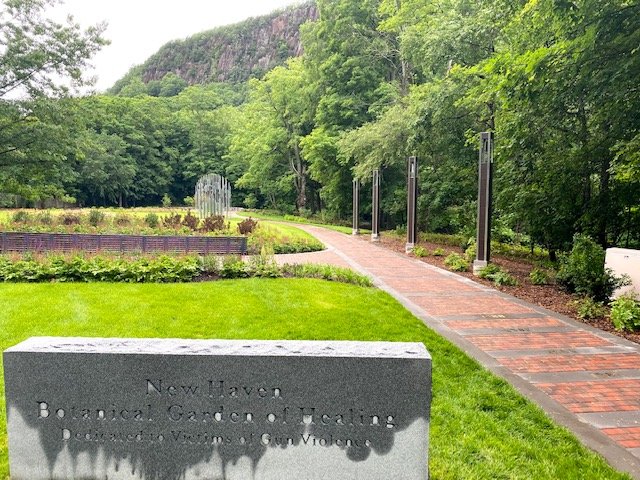
The New Haven Botanical Garden of Healing Dedicated to Victims of Gun Violence was created by the mothers of victims of gun violence as a special place to remember their loved ones. The garden is a place of hope and healing on Valley Street in New Haven, CT.